A digital press release is a structured online communication designed to announce news, strengthen brand authority, and enhance search visibility. Digital press releases combine journalistic precision with digital optimization techniques (keyword clusters, schema attributes, link structures), integrating keywords, hyperlinks, and multimedia assets to maximize online exposure. Digital press releases are as important as traditional releases because online distribution extends reach, provides measurable impact, and enables organizations to control information flow. The relevance of a digital release lies in its ability to connect credibility, visibility, and timeliness through one coordinated publication strategy.
Digital press releases enable organizations to bypass limited geographic circulation and connect directly with targeted global audiences. Optimized headlines, metadata, and anchor links increase the discoverability of announcements across search engines and media aggregators. Each publication builds domain authority, supports reputation management, and drives referral traffic through organic search. The structured composition of a digital press release ensures the information remains credible, verifiable, and easily repurposed by journalists or bloggers. This combination of visibility, control, and scalability makes digital press releases central to contemporary communication strategies that rely on narrative accuracy and analytical performance.
A digital press release requires precision, structure, and relevance to perform effectively across online media channels. Brands that approach it strategically achieve stronger visibility and engagement through accurate keyword placement, optimized multimedia assets, and distribution on high-authority networks. Each component, from the headline to the anchor links, strengthens topical alignment and search value. The most effective releases integrate factual data, active citations, and contextual backlinks that establish credibility and connect the announcement to broader industry narratives.
Consistent syntax, concise paragraphing, and logical flow sustain reader engagement and algorithmic readability. Avoiding irrelevant details, vague statements, and overextended introductions strengthens retention and ranking potential. An optimized digital press release communicates authority, enhances discoverability, and expands the digital footprint through structured, information-centered writing. This article offers a complete framework for understanding and crafting effective digital press releases. The article highlights the key benefits, and explains how digital releases improve visibility, authority, and engagement.
What Is a Digital Press Release?
A digital press release is an online communication that distributes verified, newsworthy information from an organization to digital media outlets, journalists, and public audiences. Digital press releases combine the traditional press release structure with digital optimization techniques to increase visibility, engagement, and relevance across search engines and content networks. The format integrates multimedia assets, including images, videos, and infographics, to strengthen storytelling and capture user attention within the digital environment. Each element functions strategically to support narrative clarity, visual appeal, and contextual authority in online distribution ecosystems.
A digital press release operates as an SEO-driven publication that integrates structured data, internal and external hyperlinks, and optimized metadata to enhance search engine indexation and user accessibility. Hyperlinks guide audiences toward relevant landing pages or supporting resources, and establish topical continuity between the release and the organizational digital footprint. This structure transforms a standard announcement into an interconnected web asset that strengthens brand credibility and search performance simultaneously.
The format enables direct distribution through company websites, online newsrooms, digital wire services, and social media platforms. This immediate accessibility expands reach and accelerates content circulation across digital channels. Each release delivers measurable outcomes, including increased referral traffic, organic visibility, and earned coverage from reputable publications (industry journals, verified outlets, editorial syndicates). The precision of keyword integration and contextual linking ensures that the information maintains relevance and authority long after publication.
A digital press release performs best under disciplined writing and structured optimization. Effective press releases use concise syntax, factual detail, and topic-aligned vocabulary to deliver information efficiently. Strong composition avoids redundancy, vague phrasing, and excessive modifiers. Errors in structure, inconsistent terminology, and disconnected clauses reduce clarity and weaken algorithmic readability. Precision in data presentation, accuracy in linking, and continuity in tone ensure the digital press release strengthens strategic communication, brand authority, and sustained search visibility.
How Does a Digital Press Release Differ From a Traditional Press Release?
A digital press release differs from a traditional press release through its distribution method, interactive structure, and measurable impact. A traditional press release circulates through newspapers, magazines, television, or radio. A digital press release publishes directly through online news platforms, company websites, and social channels, and creates an immediate and traceable flow of information. Traditional releases deliver static, one-directional communication intended for editorial review, while digital releases promote direct interaction through shares, comments, and hyperlinks that sustain continuous engagement across digital ecosystems.
A digital press release transforms communication from publication to participation by integrating multimedia formats, including videos, infographics, and images, that extend narrative reach and audience retention. A traditional format relies on text-driven presentation, while the digital version structures information to align with search intent and topical clustering. Each component operates within a data-informed framework where visibility depends on structured markup, semantic consistency, and keyword precision. This alignment connects organizational messaging with the algorithms that distribute and rank digital content.
Measurement defines another key distinction. Traditional releases depend on circulation estimates and column value approximations that lack accuracy. Digital releases generate real-time analytics through impressions, click-through rates, and engagement metrics (audience behavior signals, performance indicators, acquisition KPIs). This precision enables performance assessment across multiple audience segments and platforms. A digital format builds traceable pathways between content visibility, referral traffic, and brand recognition, establishing quantifiable outcomes rather than assumed exposure.
A digital press release sustains longer visibility through indexable pages, backlink potential, and social sharing. The structure of a digital press release enables persistent discovery, while a traditional release loses relevance after its initial publication cycle. Digital adaptation enhances message control, strengthens brand positioning, and extends narrative influence beyond a single news moment. The structural evolution from print-based distribution to digital dissemination redefines the press release as a search asset that drives measurable authority within the online environment.
Is Issuing a Digital Press Release as Important as Issuing a Traditional One?
Issuing a digital press release holds greater strategic importance than issuing a traditional one because it delivers broader reach, real performance data, and long-term discoverability in search ecosystems. A traditional press release establishes formal authority for regulated sectors, established media networks, and legacy audiences. A unified strategy gains strength from both channels, yet the digital format drives the scale, speed, and precision required in a modern communication environment.
A digital press release distributes information across global online networks with instant access for journalists, industry analysts, and consumers. A traditional release limits visibility to geographic and publication boundaries. The digital format advances engagement through direct interaction on social platforms, comment features, and share mechanisms that expand reach through audience networks. A traditional release restricts communication to one direction, which narrows audience influence and discovery potential.
A digital press release delivers measurable outcomes through metrics that define audience reach, on-page behavior, and referral value. Each analytic signal supports informed decision-making for future content and distribution. A traditional format provides limited insight because its performance depends on circulation estimates and editorial placement (column allocations, newsroom rotations, print scheduling blocks) that rarely reflect actual reader behavior. A digital format introduces structural advantages through indexation, internal linkage, and backlink acquisition, which strengthen search visibility and domain authority. The traditional press release format offers no comparable search value and loses relevance once the publication cycle ends.
Issuing a digital press release establishes long-term visibility because its content remains accessible in search engines, industry databases, and syndicated platforms. A traditional release fades after broadcast or print rotation, which restricts its influence to a short window. A digital version retains relevance through keyword targeting, structured data, and continuous discovery across topical clusters. A traditional press release contributes to credibility, while the digital version shapes brand narratives across wider audiences with greater precision.
Digital press releases deliver strategic advantages that align communication, search optimization, and audience engagement in one integrated asset. The traditional format strengthens formal credibility, while the digital format expands reach, amplifies message velocity, and establishes measurable authority across the online landscape. An integrated approach aligns institutional trust with digital momentum, which produces the strongest overall communication impact.
What Benefits Can Be Gained From Issuing a Digital Press Release?
Benefits that can be gained from issuing a digital press release position a brand for stronger visibility, higher authority signals, and sustained commercial impact across digital ecosystems. Each advantage strengthens discoverability, accelerates audience engagement, and advances measurable progression in communication strategy and search performance.
Key benefits that can be gained from issuing a digital press release are outlined below.
1. Stronger Search Visibility and Ranking Power: A digital press release expands search footprint through indexed coverage that reaches high-authority domains, industry hubs, and frequently crawled distribution networks. This visibility increases topical alignment with priority keywords and elevates entity strength. Search engines interpret these signals as relevance indicators, which advances positioning across targeted queries. Backlink acquisition from reputable publishers strengthens domain authority and reinforces brand reliability across competitive categories.
2. Higher Brand Exposure and Credibility Signals: Digital press releases extend brand presence across influential platforms that activate interest from journalists, analysts, and buyers. This footprint expands recognition within industry conversations and strengthens brand positioning as a credible source of authoritative information. Third-party coverage amplifies legitimacy because external validation elevates trust in the accuracy and relevance of the announcement. Each placement establishes another reference point that supports long-term perception.
3. Efficient Lead Acquisition and Revenue Growth: A digital press release targets audiences with precision through industry segmentation, demographic refinement, and topical relevance alignment. This accuracy drives qualified traffic to the website and directs readers toward product pages, sign-up funnels, and conversion pathways. Readers who demonstrate interest in the topic enter the pipeline with higher intent, which improves acquisition quality and accelerates revenue outcomes. The format delivers measurable commercial impact without the high cost of traditional advertising channels (broadcast buys, print placements, offline sponsorships).
4. Narrative Control and Strategic Reputation Management: Digital press releases present information with accuracy and authority, which stabilizes how audiences interpret corporate developments, product updates, and organizational milestones. This structure directs attention toward verified facts and reduces the influence of speculation or misinformation. Public perception strengthens through consistent storytelling that reinforces core values, achievements, and brand positioning. Clear communication during high-stakes moments preserves trust and protects long-term reputation.
5. Longer Lifespan and Persistent Discoverability: A digital press release remains indexed across search engines long after the initial publication window, which maintains visibility for users researching the brand. Archived coverage continues generating impressions as readers explore related topics or industry trends. Each long-term reference strengthens the organizational digital footprint and preserves relevance across future searches.
6. Higher Engagement Across Interactive Digital Channels: Digital releases activate discussions across social networks, niche forums, and online media comment sections that encourage deeper audience involvement. Readers respond, share, and reference the content, which expands distribution through engaged communities. Each interaction signals heightened relevance and strengthens announcement reach beyond its initial audience pool.
7. Integrated Multimedia That Deepens Message Retention: A digital press release incorporates images, charts, videos, and product visuals that clarify complex updates and increase comprehension. Visual assets improve absorption of key information and strengthen recall across crowded content environments. Multimedia elements create richer storytelling moments that outperform plain text in engagement and dwell time across media-rich interfaces (interactive viewers, embedded content modules, responsive display formats).
8. Faster Authority Advancement Across Industry Topics: Digital media releases position the organization as an industry leader through structured information that highlights innovation, data backed achievements, or milestone developments. Search engines interpret consistent expert level updates as markers of authority across related queries. Industry stakeholders reference these statements during research, which reinforces the organisational leadership role.
These benefits establish digital press releases as dynamic multimedia assets within a modern communication framework. Each advantage reinforces search presence, strengthens brand authority, and accelerates audience engagement across high-value channels.
How Can You Write an Effective Digital Press Release?
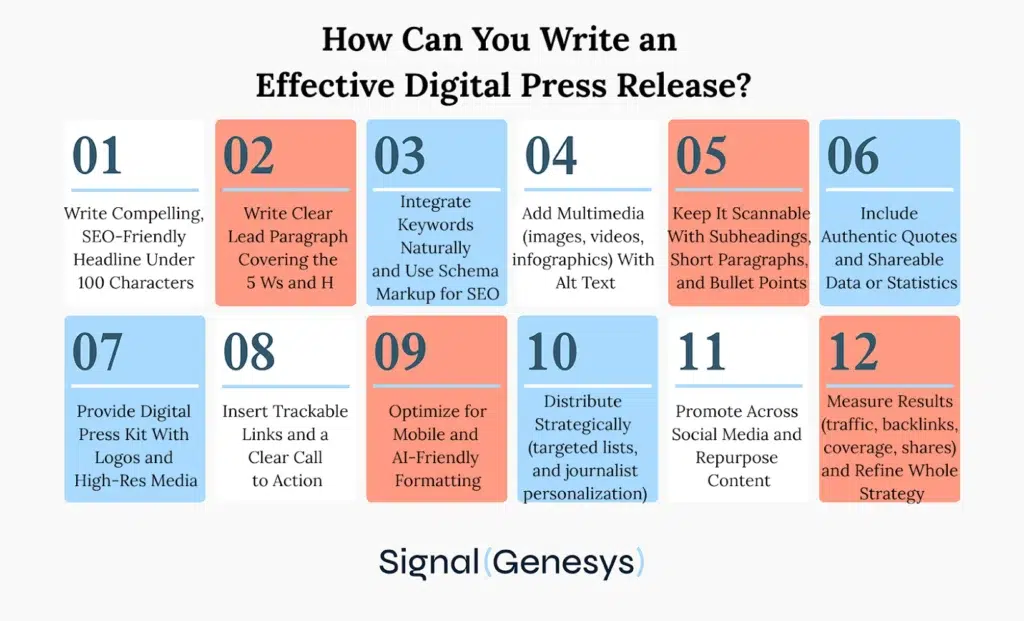
You can write an effective digital press release with a structured, news-driven format that prioritizes clarity, search visibility, and distribution precision. Each step strengthens authority signals, improves discoverability, and increases engagement across digital environments.
Step-by-step instructions outlining how to write an effective digital press release are detailed below.
1. Write Compelling, SEO-Friendly Headline Under 100 Characters
A high authority headline anchors the narrative and signals the central news value immediately. Strong language establishes direction and clarifies why the announcement matters within a competitive digital environment. Precise keywords create relevance for human readers and algorithmic systems (entity parsers, vector embeddings, semantic scorers), which increases contextual alignment across search ecosystems.
Data points or time markers elevate urgency and strengthen the news signal. Clear phrasing increases comprehension rates among journalists who evaluate multiple releases in limited time cycles. Headlines that reference a specific action or milestone generate immediate interpretive clarity. Strategic structure ensures maximum visibility across AI-driven reading interfaces.
2. Write Clear Lead Paragraph Covering the 5 Ws and H
A structured lead paragraph establishes the news foundation and reduces friction for readers who assess stories rapidly. Journalistic clarity sets expectations and strengthens the perceived legitimacy of the announcement. Precise sequencing of the 5 Ws and H anchors the narrative logic and increases the value of the press release as a stand-alone source.
This format supports accurate extraction for AI systems that parse factual elements for ranking and summarization. Concrete detail signals relevance for editors who prioritize high-quality information flows. A strong lead filters noise and directs attention toward the core outcome of the press release. This immediate clarity increases engagement depth across digital channels.
3. Integrate Keywords Naturally and Use Schema Markup for SEO
Strategic keyword placement increases semantic alignment across structured and unstructured search environments. Rich markup elements strengthen entity recognition and improve machine interpretation of the topic clusters within the press release. Logical phrasing creates topical coherence and amplifies contextual relationships across related queries. Metadata signals relevance for AI readers that rely on structured cues for categorization.
Preserved readability ensures that journalists extract information without friction or ambiguity. Clear labeling of primary and secondary concepts strengthens authority signals in competitive search verticals. This integration establishes the release as a reliable data source for humans and algorithms.
4. Add Multimedia (images, videos, infographics) With Alt Text
High resolution multimedia strengthens message retention and creates multi-channel engagement pathways. Strategic selection of images and videos reinforces narrative themes and supports deeper interpretation of the announcement. Descriptive alt text increases accessibility and provides search engines with structured cues that improve topical indexing. File names that reference core entities increase signal relevance across visual search frameworks.
Multimedia placement creates visual breaks that support faster scanning and higher comprehension accuracy. Clear alignment between visuals and narrative content strengthens the overall coherence of the press release. This structured approach elevates storytelling authority across digital environments.
5. Keep It Scannable With Subheadings, Short Paragraphs, and Bullet Points
A scannable structure increases reading efficiency for journalists who evaluate stories under strict time pressure. Concise paragraphs maintain narrative momentum and prevent information fatigue. Subheadings clarify topic transitions and support rapid extraction of key insights. Bullet points guide attention toward data, milestones, and technical details that influence coverage decisions.
Structured formatting increases press release compatibility with AI readers that prioritize segmented content. Clean design eliminates friction within mobile interfaces where vertical layout dominates. Each structural element contributes to a clearer, more authoritative reading experience.
6. Include Authentic Quotes and Shareable Data or Statistics
Authentic quotes introduce expert interpretation and strengthen message credibility. Direct statements from leadership or specialists add narrative depth and differentiate the release from generic corporate updates. Precise data points validate the news value and elevate the informational rigor of the announcement.
Metrics increase shareability across digital platforms where concise insights outperform general commentary. Quotes that address industry relevance increase appeal for journalists seeking authoritative viewpoints. Well selected statistics reinforce the strategic positioning of the organisation within its industry sector. This combination produces a richer, more multidimensional communication asset.
7. Provide Digital Press Kit With Logos and High-Res Media
A digital press kit centralizes essential assets and increases accuracy in downstream coverage. High resolution images ensure that publications maintain visual quality across print and digital formats. Clear file naming conventions strengthen organization and reduce friction for editors who publish quickly.
Brand logos create consistency across placements and reinforce identity signals for readers who encounter the announcement across multiple channels. Structured folders simplify navigation and increase the likelihood of complete coverage. Supplemental documents provide deeper technical context for journalists who require additional detail. This cohesive asset library increases the overall utility of the press release.
8. Insert Trackable Links and a Clear Call to Action
Trackable links establish measurable pathways that reveal audience behavior across channels. Precise anchor text increases relevance and supports accurate interpretation of linked resources. Clear calls to action direct readers toward the next strategic interaction and reinforce the purpose of the narrative.
Trackable URLs generate data that clarifies which elements of the release produce engagement. Strong link structure increases the connectivity of the press release across the broader digital ecosystem (referral pathways, crawl networks, indexation flows). Each link reinforces the thematic arc and strengthens topical coherence. This integrated system transforms the release into a performance-driven asset.
9. Optimize for Mobile and AI-Friendly Formatting
Mobile-first layout increases readability for journalists and audiences who navigate content through compact screens. Short paragraphs reduce cognitive load and support rapid interpretation in scroll-based environments. Structured metadata improves extraction accuracy for AI systems that prioritize contextual signals. Clean formatting increases compatibility with voice interfaces and predictive search technologies.
Precise typography strengthens clarity across varying device resolutions. Logical sequencing of information improves comprehension in environments where attention spans vary significantly. This optimization ensures that the release maintains authority across every digital interface.
10. Distribute Strategically (targeted lists, timing, and journalist personalization)
Targeted distribution aligns the release with audiences that already seek information within the domain of the selected topic. Publication-level selectivity increases credibility and strengthens relationships with journalists who prioritize relevance. Segment-specific outreach increases placement quality and positions the story within the correct editorial context. Timed distribution aligns with news cycles and maximizes visibility during high engagement windows.
Clear messaging within outreach emails increases open rates and encourages deeper evaluation. Strong targeting elevates the release from a generic announcement to a high-value editorial resource. Each distribution decision strengthens the long-term visibility of the press release.
11. Promote Across Social Media and Repurpose Content
Social platforms extend the reach of a digital press release and amplify its ability to influence industry conversations. Concise excerpts increase shareability and generate engagement among readers who prefer fast content formats. Platform-native formatting increases compatibility with algorithmic feeds that prioritize clarity and relevance.
Strategic timing increases visibility during peak activity cycles and strengthens initial momentum. Tagging relevant partners increases cross-promotional reach and builds broader industry recognition. Direct links drive traffic toward the full release and sustain visibility across multiple touchpoints. Coordinated messaging ensures consistent interpretation across audiences.
12. Measure Results (traffic, backlinks, coverage, shares) and Refine Whole Strategy
Performance metrics reveal how audiences interpret and interact with the release across channels. Traffic trends show which angles resonate with journalists and readers in real time. Engagement patterns identify the structural elements that produce the highest impact within competitive digital environments. Link performance highlights which calls to action generate meaningful downstream activity.
Social indicators clarify which statements or data points attract broader conversation. Keyword performance reveals how effectively the release aligns with search demand and topical clusters. Insight-driven refinement strengthens the long-term authority of every future release.
These steps form a complete framework for writing an effective digital press release that performs across search ecosystems, editorial channels, and social platforms. Each element advances authority, clarity, and engagement, which positions the announcement to achieve strong visibility across high value audiences.
Which Tone Works Best for Writing a Digital Press Release?
Tone that works best for writing a digital press release emphasizes clarity, authority, and factual accuracy to create content that journalists and online audiences trust and engage with. A professional and objective tone projects credibility and positions the company as an expert in its industry. Writing in third person ensures impartiality, and presents the announcement as a newsworthy event rather than a marketing message. Short sentences and concise paragraphs make the content scannable for digital readers, while headline clarity and structured subheadings guide journalists to the most relevant information quickly.
Quotes from executives or subject-matter experts add a human element, which delivers authenticity without undermining objectivity. Ensure the tone remains authoritative and confident to convey expertise on the topic while highlighting the significance of the news. For major announcements such as mergers, crisis responses, or regulatory updates, maintain a highly formal and neutral tone that emphasizes transparency and accountability. Event announcements, awards, or milestones allow subtle engagement and enthusiasm through vibrant quotes, while the main body remains factual.
Digital optimization requires language that ensures effective keyword integration, concise messaging, and shareability to enhance search visibility and audience reach. Scannable formatting, such as bullet points or short lists, increases accessibility and encourages deeper engagement. Multimedia elements (interactive assets, data visualizations, embedded media) work best when the tone complements them, and provides context without exaggeration. Balancing journalistic rigor with digital readability ensures the release meets the needs of editors, reporters, and online readers simultaneously.
Curate a tone that communicates newsworthiness and relevance to make the story compelling without promotional exaggeration. Writing with authority, clarity, and structured presentation increases the likelihood that the content is picked up, accurately reported, and widely shared. A consistent, professional, and digitally aware tone strengthens credibility, reinforces brand authority, and amplifies the impact of the announcement across all platforms.
Which Templates or Formats Are Most Effective for a Digital Press Release?
Templates or formats that are most effective for a digital press release provide a structured, ready-to-use framework for communicating news online with clarity, authority, and search visibility. Each template combines journalistic rigor with digital optimization, integrating headline strategies, multimedia elements, SEO-friendly copy, and clear calls to action.
5 ready-to-use digital press release templates are given below.
Template 1: Product Launch Press Release
FOR IMMEDIATE RELEASE
[Company Name] Launches [Product Name], a Revolutionary Solution for [Problem It Solves]
[Subheadline: Optional Secondary Headline Providing Additional Context]
[CITY, STATE] – [DATE] – [Company Name], a leading [industry description], announced today the launch of [Product Name], designed to transform the way [target audience] addresses [core problem]. The platform delivers [primary benefit] and addresses the persistent challenge of [specific issue] with [unique feature or solution].
[Product Name] offers a range of advanced features, including [Key Feature 1: brief description], [Key Feature 2: brief description], and [Key Feature 3: brief description]. The solution integrates seamlessly into existing workflows and supports [specific outcomes, e.g., improved productivity, cost savings, user engagement]. Early adopters report measurable gains in [metric, e.g., operational efficiency, conversion rates, performance].
“[Insert executive quote highlighting the product’s impact, strategic vision, or value],” said [Executive Name], [Title] at [Company Name]. “This launch reflects our ongoing commitment to innovation and delivering meaningful solutions to our customers.”
[Product Name] will be available starting [Release Date] at [Purchase Location or Website]. Interested parties can learn more or schedule a demo at [Website/Link]. High-resolution images, product videos, and infographics are available [Link to Media Assets].
About [Company Name]:
[Company Name] develops innovative solutions for the [industry] sector, helping organizations streamline operations, optimize performance, and accelerate digital transformation. The company delivers scalable, secure, and high-impact technology to support enterprise growth and operational efficiency. For more information, visit [website].
Media Contact:
[Name]
[Title]
[Email]
[Phone Number]
[Social Media Handles]
Template 2: Event Announcement Press Release
FOR IMMEDIATE RELEASE
[Company Name] Announces [Event Name] to Explore [Event Theme]
[Subheadline: Highlighting Key Speakers, Dates, or Goals]
[CITY, STATE] – [DATE] – [Company Name], a [industry descriptor], will host its annual [Event Name] from [Start Date] to [End Date] at [Location or Online Platform]. The event brings together [target audience] to explore [primary theme or purpose]. Attendees will gain access to expert insights, live demos, and networking opportunities.
The event agenda includes keynote presentations from [Speaker Names and Titles], panel discussions on [Topics], and interactive workshops focused on [Skills or Knowledge]. Registrants can participate in [specific sessions, competitions, or networking events]. Digital access options provide live streaming and on-demand content for remote participants.
“[Insert organizer quote emphasizing the event’s value, learning opportunities, and impact],” said [Organizer Name], [Title] at [Company Name]. “We are committed to delivering an immersive experience that equips participants with actionable insights and strategies.”
Registration is open at [Registration Link]. Media resources including press kits, speaker bios, and event images are available at [Link].
About [Company Name]:
[Company Name] is a leader in [industry] providing education, solutions, and platforms that enable [audience type] to advance their expertise, innovate processes, and achieve strategic outcomes. For more information, visit [website].
Media Contact:
[Name]
[Title]
[Email]
[Phone Number]
[Social Media Handles]
Template 3: Strategic Partnership Press Release
FOR IMMEDIATE RELEASE
[Company Name] Partners with [Partner Company] to [Goal/Benefit of Partnership]
[Subheadline: Expanding Digital Capabilities, Customer Value, or Market Reach]
[CITY, STATE] – [DATE] – [Company Name] and [Partner Company] announced a strategic partnership focused on delivering enhanced [product/service] capabilities to [target audience]. The collaboration leverages [Company Name]’s expertise in [specific area] with [Partner Company]’s strengths in [area] to provide [specific benefit].
The partnership enables joint development of [Products/Services], integration of [Technology or Tools], and improved user experiences across digital platforms. Combined resources support faster implementation, expanded market access, and optimized customer outcomes. Teams will collaborate on [Projects, R&D, or Launch Initiatives], targeting measurable improvements in [metric or outcome].
“[Executive quote highlighting collaboration value and shared vision],” said [Name, Title] at [Company Name]. “[Additional sentence emphasizing outcomes or innovation].”
“[Partner executive quote emphasizing synergy and expected results],” said [Name, Title] at [Partner Company]. “[Additional sentence reinforcing mutual goals].”
Boilerplates for both companies provide mission statements, industry focus, and achievements. Media kits, logos, and multimedia resources are available at [Link].
Media Contact:
[Name]
[Title]
[Email]
[Phone Number]
Template 4: Award or Recognition Press Release
FOR IMMEDIATE RELEASE
[Company Name] Receives Prestigious [Award Name] for [Achievement/Excellence]
[Subheadline: Highlighting Industry Leadership and Contribution]
[CITY, STATE] – [DATE] – [Company Name], a recognized leader in [industry], has been awarded the [Award Name] by [Awarding Organization]. The recognition highlights the company’s achievements in [specific accomplishment], underscoring its role as a benchmark in the industry.
The award honors [details of criteria, competitive landscape, and scope], validating [Company Name]’s commitment to innovation, operational excellence, and industry leadership. Selection was made by [judging panel, number of applicants, or methodology], confirming the company’s high standards and impactful results.
“[Executive quote expressing gratitude, team recognition, and ongoing commitment],” said [Name, Title]. “Receiving this award motivates our team to continue delivering measurable impact and innovative solutions.”
[Optional quote from awarding organization emphasizing significance and credibility]. Multimedia and award images are available at [Link].
About [Company Name]:
[Company Name] delivers solutions in [industry] with focus on innovation, performance, and measurable results. The company supports clients and partners through digital expertise, industry insights, and high-impact initiatives. Visit [website] for more details.
Media Contact:
[Name]
[Title]
[Email]
[Phone Number]
Template 5: Crisis Response / Service Update Press Release
FOR IMMEDIATE RELEASE
[Company Name] Issues Update on [Service/Platform] Interruption and Resolution Measures
[Subheadline: Outlining Actions, Timeline, and Customer Guidance]
[CITY, STATE] – [DATE] – [Company Name] provides an official update regarding the recent [type of service disruption] affecting [specific segment/customers]. The incident originated from [brief description of root cause], and the company deployed corrective measures to restore full functionality. Customers now have stable access while monitoring continues to ensure operational reliability.
Support teams engaged affected users via [channels] and provided real-time updates throughout the incident. Corrective actions include [technical measures or process changes], while preventive measures are under implementation to safeguard future performance. Leadership reviewed operational logs and system metrics to verify stability and maintain transparency.
“[Executive quote demonstrating accountability, reassurance, and next steps],” said [Name, Title]. “Our priority remains providing a secure, stable, and reliable digital environment for all stakeholders.”
Customers may access service updates, FAQs, and additional resources at [Link]. High-resolution images, system dashboards, and explanatory videos are available for media use.
About [Company Name]:
[Company Name] delivers technology solutions and digital infrastructure services across [industry]. The company emphasizes operational integrity, security, and user trust, supporting a global client base. Visit [website URL] for additional information.
Media Contact:
[Name]
[Title]
[Email]
[Phone Number]
These ready-to-use templates combine the essential elements of compelling headlines, lead paragraphs summarizing the five Ws and H, quotes and multimedia with advanced SEO and digital engagement strategies. Leveraging these formats ensures press releases remain professional, accessible, and optimized for search engines and social media platforms. Adapting each template to the specific news scenario allows organizations to maintain consistent messaging while highlighting the most critical details.
What Mistakes Should Be Avoided in a Digital Press Release?
Mistakes that should be avoided in a digital press release include errors in content, tone, structure, and distribution that reduce credibility and limit visibility. Failing to establish newsworthiness represents the most critical mistake. Effective announcements offer timely, relevant, and significant information that matters to journalists and the target audience. Releases that focus on internal updates or routine company activity without a clear angle rarely achieve media coverage. Lack of clarity in the main message diminishes impact and leaves editors uncertain about the story value.
Overly promotional language undermines professional credibility. Buzzwords, exaggerated claims, or marketing jargon distract from the factual narrative and reduce journalist trust. Incorporate executive quotes that provide insight or context rather than generic praise. Excessive details dilute the story while keeping releases concise between 400 and 600 words ensures editors absorb key points quickly. Visuals increase engagement and pickup rates. Press releases without images, videos, or infographics (brand assets, event documentation, data charts) appear less compelling in the digital landscape and limit audience understanding of the announcement.
Formatting errors disrupt readability and reduce digital performance. Weak or vague headlines fail to capture attention or incorporate relevant keywords for search visibility. Ignoring the inverted pyramid structure buries essential information, and decreases the chances of immediate comprehension. Large blocks of text without subheadings, bullet points, or short paragraphs make scanning difficult, which reduces engagement on screens. Proofreading lapses and factual inaccuracies directly damage credibility and may result in media outlets disregarding the release entirely.
Distribution mistakes compromise effectiveness and reach. Sending press releases to irrelevant journalists or media outlets wastes resources and decreases coverage probability. Timing the release during high-traffic news periods or off-hours limits visibility. Omitting accurate contact information prevents follow-up inquiries and obstructs editorial access to additional details. Ignoring SEO best practices reduces discoverability, while failing to share releases across owned digital channels limits overall exposure.
Avoiding these mistakes requires a disciplined approach focused on newsworthiness, precision, and audience relevance. Each element of the release, from headline to multimedia, contributes to clarity, authority, and digital performance. Structured presentation, accurate information, and careful targeting ensure press releases achieve journalist adoption and online visibility, which establishes the company as a credible, authoritative source of news.
How Should a Digital Press Release Be Optimized for SEO and Online Visibility?
A digital press release should be optimized for SEO and online visibility by integrating keyword strategy, content structure, multimedia assets, authoritative linking, meta optimization, and strategic distribution. Effective headlines summarize the core news succinctly, include a primary keyword, and remain under 70 characters for optimal search display. Subheadings reinforce the topic, and incorporate semantic and related keywords to build topical authority.
Keyword strategy drives discoverability and relevance. Conduct research to identify high-intent keywords and long-tail phrases aligned with audience interests, journalist queries, and industry trends. Integrate keywords naturally across headlines, subheadings, and body content to avoid over-optimization or stuffing. Include related semantic terms to establish comprehensive topical coverage that signals authority.
Incorporate internal links to high-value pages within your website and external references from reputable sources to strengthen credibility and contextual relevance. Limit link volume to maintain link equity and preserve focus on primary topics. Content structure enhances readability, engagement, and SEO performance. Apply the inverted pyramid format to place critical information first, followed by supporting details and contextual background.
Use concise sentences, short paragraphs, and clear subheadings to facilitate scanning by journalists and online readers. Highlight key data points, metrics, or quotes from executives with embedded internal links to thought leadership profiles. This approach reinforces authority, provides verifiable sources, and encourages organic backlinks from media outlets referencing your release. Include geographic identifiers or maps for local SEO advantages and ensure all media assets are accessible across devices and platforms (mobile environments, tablet interfaces, desktop displays).
High-quality multimedia increases engagement, retention, and indexing opportunities. Include relevant images, infographics, and videos that visualize core information. Optimize all media with descriptive filenames, alt text containing keywords, and captions that provide context. Embed links to company resources or supplementary reports within multimedia content to reinforce authority and provide journalists with comprehensive sources.
Monitoring and analytics refine SEO strategy and optimize future releases. Track keyword rankings, referral traffic, engagement metrics, and backlink performance using analytics tools. Identify which headlines, subheadings, multimedia assets, and link placements produce maximum visibility and coverage. Implement iterative updates to content structure, multimedia strategy, and keyword integration to strengthen topical authority. Regular assessment of distribution channels and audience response ensures releases reach journalists efficiently and maintain consistent search presence.
Which Tools Help in Writing, Optimizing, and Sharing a Digital Press Release?
Tools that help in writing, optimizing, and sharing a digital press release include platforms that strengthen authorship, elevate distribution quality, verify originality, and accelerate newsroom. Digital press release workflows advance through structured tooling that enhances narrative formation, verifies content integrity, and delivers broad market reach across trusted media surfaces.
Top 5 tools that help in writing, optimizing and sharing a digital press release are reviewed below.
1. Signal Genesys
Signal Genesys strengthens digital press releases through a distribution engine engineered for SEO visibility, entity authorship, and controlled syndication. The infrastructure builds authority signals across high-value domains, since each release indexes through branded publisher pathways that transfer relevance to the originating entity. White label formatting keeps brand identity intact across every endpoint, which ensures a unified communication footprint.
Multimedia (editorial image sets, branded explainer videos, podcast-format audio clips) integration elevates engagement, since images, videos, and audio assets support narrative depth and improve search performance. Real-time analytics deliver actionable intelligence on placement traction, audience behavior, and link equity flow across news networks. Signal Genesys maintains speed, reach, and editorial control, which benefits agencies and teams that prioritize measurable search impact and efficient publishing cycles.
2. Copy.ai
Copy.ai accelerates high-quality announcement production through a structured AI press release generator that converts raw details into newsroom-ready documents. The engine processes core inputs like event information, leadership quotes, market data, and positioning elements. Then, Copy.ai builds a narrative that aligns with AP conventions and professional formatting standards. GTM teams produce consistent releases that maintain message authority across every announcement cycle, since the tool eliminates structural variation and maintains linguistic precision.
Headlines and leads emerge with strong news angles, which improves pitch relevance and journalist response rates. Copy.ai reduces drafting time while preserving strategic focus, which enables teams to synchronize announcements with product launches, funding reveals, or partnership rollouts.
3. Originality.ai
Originality.ai verifies the authenticity of digital press release content through a suite of detection and quality-control engines built for professional publishers. The AI detection model identifies generative text with high accuracy across major LLM architectures, which allows editorial teams to confirm authorship and preserve content integrity.
The plagiarism scanner evaluates source overlap at scale, and the dashboard logs scan histories across multi-user environments for accountability. Readability, grammar, and fact-check systems reinforce content clarity before distribution, which reduces editorial risk.
4. Business Wire
Business Wire delivers digital press releases into financial terminals, newsroom systems, and global media networks with direct editorial integration. Business Wire circuits reach major organizations that track market-moving announcements, which strengthens credibility and ensures journalist visibility. The platform supports regulatory filings, investor disclosures, and enterprise-level distribution strategies through secure submission pathways and stringent editorial review.
Multimedia support expands digital footprint, since embedded assets increase engagement across global engines and publisher platforms. Business Wire provides detailed analytics that surface pickup patterns, geographic distribution, and audience interaction metrics, which informs future communication strategy high-stakes environments.
5. PRNEWS.IO
PRNEWS.IO distributes digital press releases across international markets through fixed-price placements that guarantee publication on selected media outlets. The marketplace structure gives brands full visibility into outlet authority, audience focus, and publication criteria, which supports targeted regional expansion and niche segmentation. Permanent backlinks produced through sponsored placements strengthen search visibility and long-term brand equity.
The platform supports multilingual distribution across dozens of regions, which positions global campaigns for consistent exposure. Fast turnaround times shorten campaign cycles, and the dashboard centralizes campaign oversight for teams that manage multiple geographic markets or industry verticals.
Digital press releases outperform traditional communication models once teams integrate creation, verification, and distribution across specialized tools. Each platform enhances a different stage of the workflow, and combined implementation produces releases that carry stronger authority signals and gain broader publisher access.
Are Social Media Platforms Enough for Distributing a Digital Press Release?
No, social media platforms are not enough for distributing a digital press release because they address one aspect of the distribution spectrum. Social platforms amplify messages, engage audiences directly, and drive traffic to your website, but they do not guarantee media coverage, journalist pickup, or long-term visibility. Relying solely on social media limits press release reach, authority, and credibility, and exposes announcement to algorithmic volatility, information overload, and short-lived engagement.
Social media excels at direct-to-consumer communication and interactive engagement. Posts that include multimedia such as videos, infographics, or interactive charts increase shareability and capture attention quickly. Hashtags and platform-specific features extend visibility within targeted communities. Social channels allow rapid responses and tracking engagement metrics in real-time. These capabilities amplify awareness and support the broader distribution strategy, but they do not substitute for formal news syndication or authoritative reporting.
Relying exclusively on social media undermines journalist outreach and media credibility. Reporters and editors continue to source stories from professional wire services, direct pitches, and industry-specific publications (trade intelligence portals, niche editorial hubs, sector-specific newsboards). Social feeds deliver fragmented information in high volumes, which reduces visibility for time-sensitive or newsworthy content. Algorithm changes frequently alter reach, which makes the timing and impact of social posts unpredictable. Press releases distributed solely through social channels are perceived as marketing announcements rather than verifiable news.
A comprehensive distribution strategy integrates social media with traditional and digital channels. Reputable wire services extend coverage to thousands of media outlets, news aggregators, and niche publications to ensure authoritative distribution that enhances credibility and generates high-quality backlinks. Direct media outreach allows personalized, targeted engagement with journalists covering specific topics, which improves pickup rates. Publishing the full press release on an official newsroom or company website establishes a permanent, SEO-friendly source of information.
How Can Engagement and Media Coverage Be Increased for a Digital Press Release?
Engagement and media coverage can be increased for a digital press release through newsworthy content, precise editorial structure, targeted distribution, authoritative multimedia, and sustained journalist relationships. A digital press release gains traction when each element advances clarity, relevance, and verifiable value. Strong performance emerges from deliberate editorial choices, disciplined audience targeting, and consistent integration of data-driven insights that elevate the announcement beyond promotional messaging.
A digital press release attracts attention when the announcement delivers clear public value. Product launches, research findings, and high-impact partnerships establish relevance and signal significance to reporters monitoring shifts in a market or industry. A headline that states the core development with precision increases open rates and sets clear expectations for the narrative. A direct lede that answers the five Ws provides immediate context and positions the announcement as credible news, not brand commentary.
Concise paragraphs, structured logic, and accessible language accelerate reading speed and reinforce release authority. Quotes from executives or subject-matter experts strengthen the narrative through insight rather than opinion, while data points, benchmarks, or original research supply factual weight that supports journalist evaluation. A digital press release generates greater engagement when it incorporates visual assets that deepen understanding.
High-resolution images, technical diagrams, charts, and short-form video segments reinforce the story and give journalists assets that integrate easily into coverage. Each element creates additional indexing opportunities across search engines and news aggregators (news XML feeds, crawler-indexed media repositories, algorithmic discovery panels). Alt text, descriptive filenames, and structured captions improve discoverability and reinforce topical relevance. A newsroom link that houses extended multimedia, datasets, or background explanations anchors the release in a central authoritative source, which strengthens trust and encourages longer reader sessions.
A digital press release reaches stronger media coverage through targeted distribution. A curated media list aligned with industry verticals, geographic relevance, and editorial beats ensures that journalists receive information tailored to their coverage area. Personalized emails with precise summaries and direct references to recent reports by targeted journalists establish credibility and differentiate the announcement from mass-market blasts. Professional distribution platforms extend the release to established outlets, industry publications, and news feeds indexed across search engines. This structured syndication increases visibility, supports long-term search performance, and amplifies reach beyond brand-owned channels.
A digital press release accelerates impact when timing, sequencing, and relationship-building form part of an ongoing strategy. Tuesday through Thursday morning distribution aligns with newsroom workflows and increases the likelihood of review. Follow-up messages sent with specific context acknowledge the journalistic perspective and elevate the interaction beyond transactional outreach. Long-term relationship development through consistent engagement, expert commentary, and availability for rapid response positions the brand as a reliable information source. Consistent tracking of referral traffic, backlinks, media pickups, and social engagement identifies performance patterns that inform future campaigns and refine targeting.
How Do You Decide When to Publish a Digital Press Release Versus a Traditional One?
You decide when to publish a digital press release versus a traditional one through a clear assessment of audience behavior, communication intent, and measurement expectations. A precise decision emerges from understanding how each format influences reach, authority signals, and the speed of market response. Digital releases drive performance across search ecosystems and social platforms, while traditional releases secure institutional credibility through established media channels.
A digital press release delivers superior value when your announcement aims for real-time visibility, measurable impact, and online authority growth. Younger audiences interact with news through digital surfaces, so digital distribution places your announcement where discovery already occurs. Product innovations, original datasets, and partnership updates gain stronger traction in digital ecosystems because reporters and analysts assess relevance through search signals, backlink patterns, and social proof (referral graph movements, domain authority shifts, query-level click signals).
A digital release strengthens SEO because authoritative pickups increase domain equity and search visibility. Multimedia assets elevate comprehension and engagement, since journalists evaluate stories that include structured visual context. Analytics dashboards provide precise performance measurement through referral traffic, link quality, engagement velocity, and conversion behavior, which enables a controlled feedback loop for your PR program.
A traditional press release creates greater impact when your announcement requires institutional authority or when specific demographics rely on legacy channels for trusted information. Older audiences engage through newspapers, trade magazines, television, and radio, so traditional distribution aligns the message with their established consumption patterns. High-stakes announcements such as regulatory updates, investor communications, mergers, and crisis statements gain credibility through traditional outlets because these channels enforce structured editorial standards.
Long-form print features and broadcast coverage position the story within authoritative contexts that increase brand gravitas. Traditional media cycles introduce longer lead times, which supports deeper narrative framing and stronger message control for sensitive or reputation-critical updates. A hybrid approach produces maximum reach when a single format limits potential impact. A traditional release placed in national or sector-specific outlets establishes legitimacy through recognized editorial environments.
In contrast, a digital release amplifies the same announcement across search engines, social surfaces, and industry communities. Digital content reinforces traditional coverage through backlinks, indexed citations, and social re-circulation, which keeps the announcement discoverable long after the print or broadcast cycle closes. Traditional placement strengthens digital performance because authoritative outlets increase link credibility, search value, and long-term visibility.
What Are Strong Examples of Well-Crafted Digital Press Releases?
Strong digital press releases establish authority through structural clarity, narrative precision, and distribution strategies that match the pace of digital news cycles. Well-crafted releases create information pathways that guide journalists, algorithms, and stakeholders toward a single, verifiable message.
5 strong examples of well-crafted digital press releases are given below.
1. Dove

2. PUMA

3. Dunkin’

4. Deutsche Bank

5. Kering

These examples reveal how disciplined execution elevates a digital press release from a basic announcement into a strategic communication asset. Each example demonstrates how strong structural choices, precise language, and verified data establish trust across newsroom systems and search environments.
How Can the Performance and Impact of a Digital Press Release Be Measured?
The performance and impact of a digital press release can be measured through a structured evaluation of media visibility, audience behavior, on-site actions, search value, and brand perception. Each metric reveals a distinct layer of influence, and each data point establishes a traceable connection between the announcement and market response. A strong measurement framework captures distribution breadth, audience depth, conversion relevance, and long-tail authority signals so the release functions as a communication asset and a performance asset.
Media coverage defines the first tier of performance. Quantity reveals how widely the release entered news ecosystems, while quality establishes the authority level of every pickup across industry, business, and regional sources. A high-authority outlet introduces stronger validation, since domain strength influences search visibility, newsroom circulation, and expert readership. Spread analysis clarifies whether the release penetrated the correct niches, since business outlets, trade journals, and geographic publications (sector-specific news portals, industry wire services, localized editorial networks) reach distinct segments with different expectations.
Audience reach and impressions validate distribution velocity. Unique views quantify distinct readers, while impressions reveal total exposure across news surfaces, aggregated feeds, and syndicated networks. Social mentions extend reach into secondary networks where influencers, analysts, and sector communities amplify the story. Each mention contributes a signal that blends discovery, trust, and relevance. Distribution patterns across platforms reflect how different audiences engage with the story, and this pattern establishes benchmarks for future releases.
Website traffic and conversions measure intent. Referral traffic identifies which outlets drive qualified sessions rather than surface-level clicks. Visitor behavior reveals message resonance through bounce rate, session depth, and time on site. These behavioral indicators define whether the release performed as an entry point or as a transactional bridge to branded properties. Conversion tracking isolates actions tied to the release through UTM parameters, tracked URLs, or promo identifiers. Lead generation metrics clarify whether the announcement activated real demand, since form submissions, inquiries, and demo requests indicate that the release influenced decision-stage behavior.
Online visibility and SEO define long-term impact. Search rankings for key terms reveal whether the release strengthened digital authority within competitive query spaces. Branded search volume increases indicate that the announcement triggered direct interest, since users actively sought the organization rather than passively encountering it. Backlink acquisition demonstrates structural value, since authoritative links elevate domain equity and strengthen future content performance.
Brand impact completes the evaluation. Sentiment analysis reveals how audiences interpreted the announcement across social networks and community forums. Positive sentiment strengthens perception, while negative sentiment identifies friction points that require narrative correction. Market surveys conducted before and after distribution quantify changes in awareness and recall with precision. This data closes the loop between communication outcomes and brand strategy, since every release either strengthens authority or exposes gaps in message architecture.